
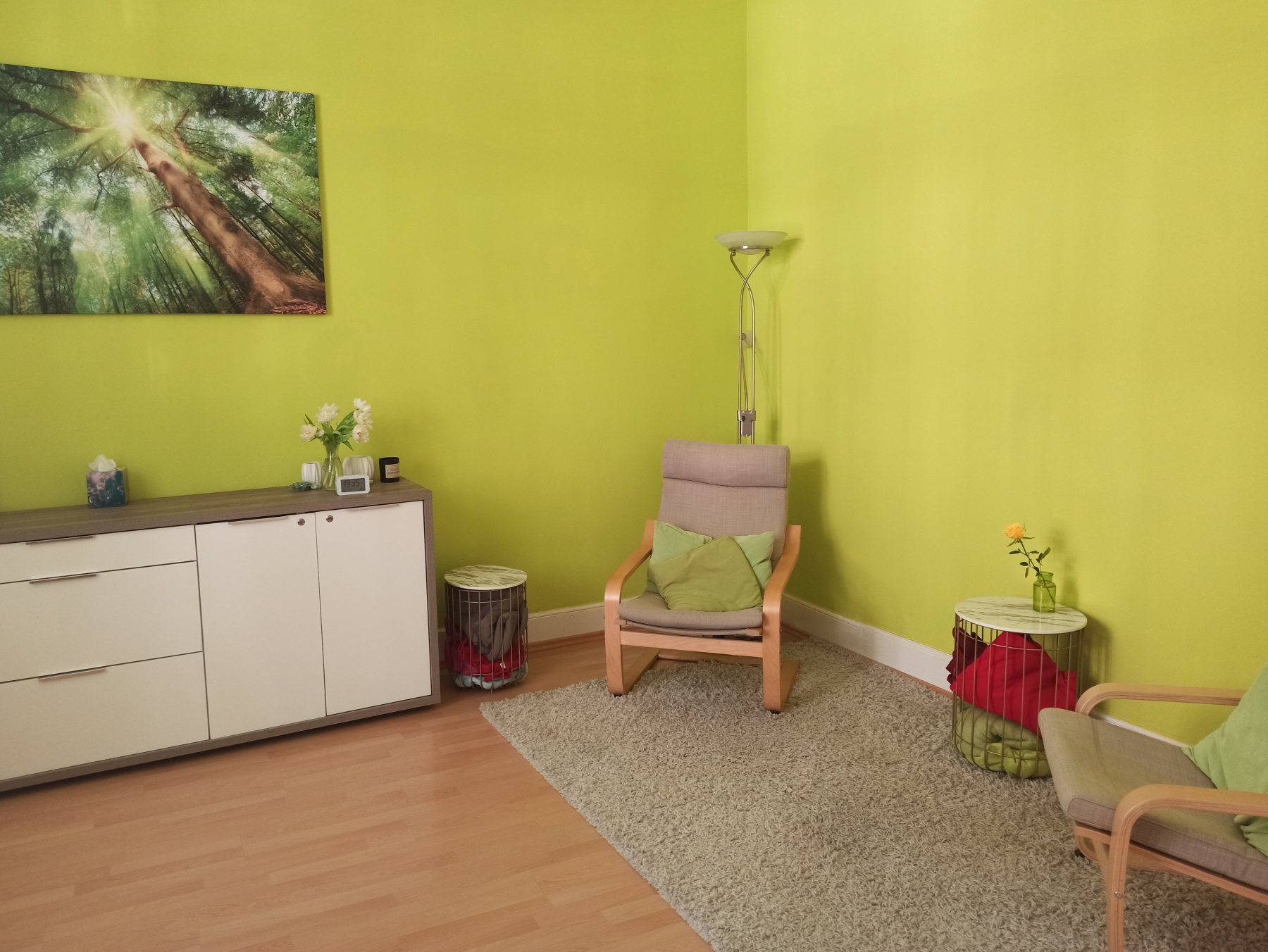
You do not have to be in crisis to come to therapy. It is enough that something deserves more attention than everyday life leaves room for, whether it has been on your mind for a long time or has just thrown you off balance.
Nobody is entirely healthy or entirely ill – therapy can be worthwhile for anyone.
What Gestalt therapy means to me
Gestalt therapy is a form of psychotherapy that pays attention to the process you are in and to the one that develops between us. What concerns you now comes up in our work together, and its roots tend to go back to earlier relationships. The approach is experiential: whatever we carry with us from the past, we experience here and now, so we are never simply at the mercy of what was or what might come. From one moment to the next, we decide for ourselves what we engage with and what we leave alone.
For a first impression, this short animation in English explains the Gestalt cycle, a basic principle of Gestalt therapy. It is made for children, but it makes a good starting point. It also touches on the typical ways we protect ourselves in contact with our surroundings and with ourselves.
Watch “The Gestalt Cycle” on YouTube (4:27) →
The video by Sojo Animation (Sophie Johnson-Hill) opens on YouTube (Google).
What happens in our sessions
We begin with what brings you here. Some people arrive with a clear question, while others only know that something has been weighing on them for a long time. Both are fine places to start.
From there we talk, and I listen for more than the words. How you describe something says a lot, and so does what happens in your body while you do. Patterns from your life often show up between us as well, and when they do, we can look at them as they happen. Now and then we try an exercise that lets you experience something directly instead of only talking about it.
One of these is chair work: you imagine a person from your life, or a part of yourself, sitting in an empty chair and speak to them directly. You can then change chairs and answer from their point of view, which can show you something you could not see before. When two parts of you are at odds, each gets its own chair, so that they can speak with each other. This is only done if it feels right to you.
Many of the things that trouble us have never been fully lived through. Gestalt therapy calls these experiences open gestalts: they keep asking for attention long after the situation has passed, and over time they can harden into a pattern that keeps repeating. Think of a separation you never got over, or a sense of belonging you lost when you moved away. When we go through such an experience again in therapy, with support, it may never be closed for good, but it can change: new aspects come into view, and what had become rigid grows softer and more flexible.
A good deal of my work is about understanding the ways of protecting ourselves that grew out of earlier experiences. As children we found our own solutions, and they made sense at the time. A child who had to manage everything alone, because no one else did, may become an adult who finds it hard to accept help. A child who learned to keep everyone content by adapting may later struggle to say no, or to ask for what they need. Many of these solutions keep running in the background long after they have stopped serving us. Once we begin to feel them and not only think about them, other ways of responding come within reach.
The analytical tradition of Gestalt therapy that I work in pays close attention to this history, always in relation to your life as it is now. The aim is to see the difference between then and now, and to learn to take care of yourself.
At the center of it all is learning to face our opposites. Most of us carry a part that wants to move on and another that holds back, and each has its reasons. Usually neither has been fully heard. When the two enter into dialogue, something begins to loosen.
Counseling and psychotherapy
Counseling suits a particular situation or a period of change, when you want to understand where you stand and what you would like to do next. It can also help bridge the time while you wait for a place with a therapist covered by statutory health insurance. Psychotherapy goes deeper and usually takes longer. It is for difficulties that have been with you for a long time, and just as much for experiences that have thrown you off balance. In practice the two overlap, so you do not have to know in advance which one you need; we can find that out together.
Situations that often bring people to counseling or therapy include:
- feeling stuck in repeating relationship patterns
- carrying a persistent sense of anxiety or loneliness
- going through a separation or divorce
- losing someone close, or a sense of belonging
- moving to another country and finding your place in a different culture
- losing a job, or feeling increasingly disconnected from your work
- dealing with changes in your health or abilities
- realizing that your current life no longer fits who you are
No diagnosis is needed for counseling. For psychotherapy in my practice, an initial diagnostic assessment is required. A physician may already have made one, or we clarify it in the first sessions.
How long it takes
There is no fixed length; it depends on what you bring.
Counseling that mainly gives you information and orientation can be done in one or two sessions. If we look at a particular situation or at the story behind it, five to fifteen sessions are more usual. Some people stay longer and meet regularly as ongoing support.
In psychotherapy, a specific question can often be looked at in six to ten sessions, and brief therapy usually runs up to about twenty-five. Older, more deeply rooted patterns take longer, and then we meet for as long as it is useful. We review how it is going from time to time and decide together what is still needed.
Sessions last 50 minutes. We usually start weekly, though meeting every two weeks can also work, depending on your situation.
A way in
If you are unsure whether this is for you, a free introductory call of about 20 minutes is the easiest first step. You can ask your questions and get a feel for talking with me. A full first session tells you more, though, because we actually begin to work. Either way, you do not need to arrive with an explanation of what is wrong.
Questions you may have
What does it cost, and what about insurance?
Sessions are €90 for 50 minutes in person in Frankfurt and €70 online. A sliding scale is available on request, depending on your financial situation. You will receive an invoice or a receipt for each session.
I work in private practice as a Heilpraktiker für Psychotherapie. In Germany, this is an official license to practice psychotherapy as a non-medical practitioner, separate from the state approval (Approbation) held by psychological psychotherapists and physicians. Statutory health insurance therefore does not cover my sessions, and you pay for them yourself.
If you have private health insurance or a supplementary policy for Heilpraktiker services (Heilpraktiker-Zusatzversicherung), part of the cost may be reimbursed. This depends entirely on your policy, and some exclude psychotherapy by a Heilpraktiker. The same goes for insurance from other countries and for international or expat plans. Please ask your insurer before we begin.
Can we work online?
Yes. Online sessions are available throughout Germany and, after we have talked it through, in other European countries. I set up a secure video platform for us, so you do not need to arrange anything. If technical reasons call for another one, we can agree on that together.
In person, we meet in Frankfurt, and evenings or Saturdays can be arranged.
Can we work in English if it is not my first language?
Of course. Many of the people I work with have English as a second or third language. If something is easier to say in German, we can switch.
Is what I say confidential?
Yes. As a Heilpraktiker für Psychotherapie I commit to confidentiality, and I do not pass on any information about your treatment without your written consent, unless the law requires it.
If you would like to take a first step, you can book a free introductory call or arrange an appointment. You are just as welcome to write to me first.